

Hey friends, Happy Tuesday!
There’s one question I keep getting everywhere.
“Will AI replace us?”
And honestly… I get it. Especially if you’re still learning, this question can sit in your head all day.
Now if you ask me directly, my answer is a bit annoying.
It depends.
I know… not the answer you want. But I’m not trying to avoid it. The problem is, this question is not simple, and most of the discussions online are missing something very important.
They ignore how things actually work inside real companies. So instead of giving you a short answer, let me walk you through how I think about this.
The reality inside companies
What you see online vs what actually exists
Most AI demos you see are built on very clean setups. A few tables, nice structure, everything documented perfectly. In that world, AI looks insanely powerful.
But real projects don’t look like that at all. They’re messy, huge, and everything is connected to everything.
I worked on a lakehouse project where we spent years just connecting systems. Data was coming from APIs, Kafka streams, databases, files… and we ended up with more than a thousand tables. And honestly, that was just the starting point. On top of that, there was business logic built layer by layer over time.
So when someone says “AI can build this with a few prompts”… yeah, it sounds nice.
But it skips the hardest part.
The hard part is not writing code.
It’s understanding everything behind the code.
Companies move slower than technology
Another thing people underestimate.
Technology moves fast. Companies don’t.
If you watch what’s happening in the media, it feels like everything is already AI-driven. Like every company has figured it out and we’re already there.
But the moment you step inside a real company, you see a completely different reality.
You still find Excel running critical reports. You see systems that have been there for years and no one wants to touch them. And there’s always a big chunk of data that isn’t even integrated yet.
And changing all of this… it’s not quick.
You need to migrate systems, build pipelines, set up governance and security, and at the same time train people so they actually understand what’s going on. And all of this has to move together.
So when I hear someone saying that jobs will disappear very soon, I usually just pause for a second and think… yeah, let’s see 🙂
Not because AI is weak. But because companies don’t change overnight.
How AI changes data teams
Now let’s talk about data teams.
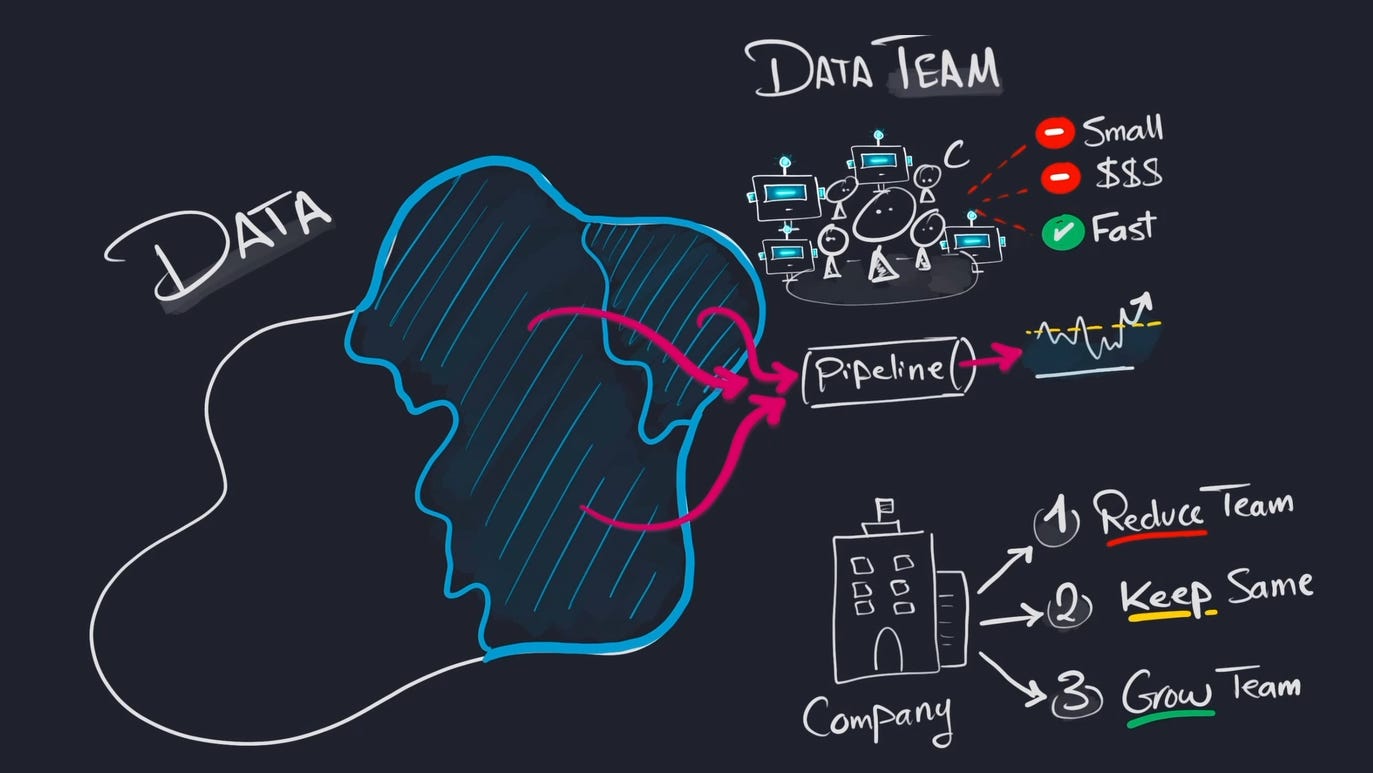
Most companies have a lot of data, but small teams. So they only process a small portion of it.
Then AI comes in and makes those teams faster. And this creates a real decision.
Do you reduce the team, keep the team, or expand?
If you reduce the team, you save cost… but nothing really improves. You’re still processing the same small portion of data, and you might even hurt quality because the team was already stretched.
If you keep the team, you start doing more. More data sources, more pipelines, more insights. This is what I see most often. It works well, but only to a certain point. Eventually, you hit a new limit.
If you expand the team, you treat AI as a growth opportunity. You invest more, improve data quality, and use a much bigger portion of your data. It costs more, but the value is much higher.
And from what I’ve seen… most companies are not rushing to reduce data teams. They either scale what they already have or start investing more.
Because in the end, AI doesn’t reduce the need for data work.
It actually increases it.
What I think about the job roles
Instead of asking “Will AI replace data analysts or engineers?”, I prefer to break the job into parts. Because not everything is equal.
Let’s start with data analysts.
Will AI Replace Data Analysts?
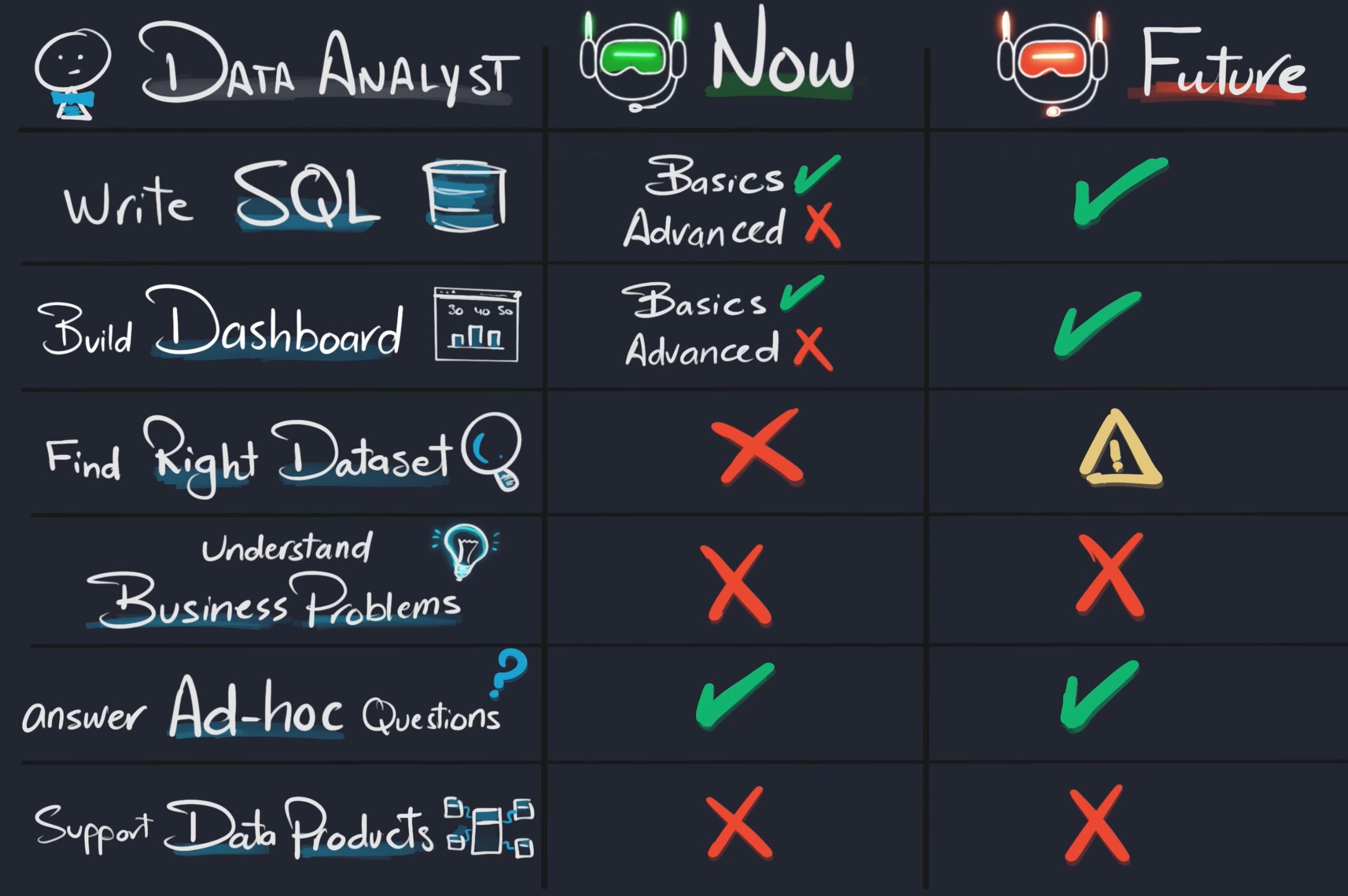
SQL
is the first thing everyone talks about. And yes, AI is already very good here. You describe what you want, and it gives you a query. For simple things, it works great.
But once things get messy, multiple joins, unclear schemas, relationships… you start to see the limits. It doesn’t really understand your data, it just predicts.
Still, if I’m honest, this part will mostly be automated.
Dashboards:
AI can generate charts, but real dashboards are not just visuals. They include business logic, multiple datasets, filters, edge cases… and most importantly, trust.
At the end, someone still needs to look at the numbers and say, “this is correct.”
Then there’s something people don’t talk about enough.
Finding the right data:
In real companies, this is not obvious at all. You might have multiple tables that look the same, different systems storing similar data, and no clear documentation.
So what do you rely on? Experience. Context. Conversations.
This is where analysts actually spend a lot of their time, and this is where AI struggles the most.
Understanding the business:
Not just what people ask… but what they actually mean. Sitting with stakeholders, asking better questions, translating vague ideas into something measurable.
This is not about tools anymore. This is about thinking.
And here, AI is not even close.
Now to be fair, there is one part that will disappear.
The repetitive stuff. The small requests, the same questions again and again, the quick checks.
And honestly… that’s a good thing.
So when people ask me if AI will replace data analysts, my answer is always the same.
If your work is mostly writing queries and building simple dashboards, then yes, a big part can be automated.
But if you understand the business, work closely with people, and build things others rely on, then you’re not being replaced.
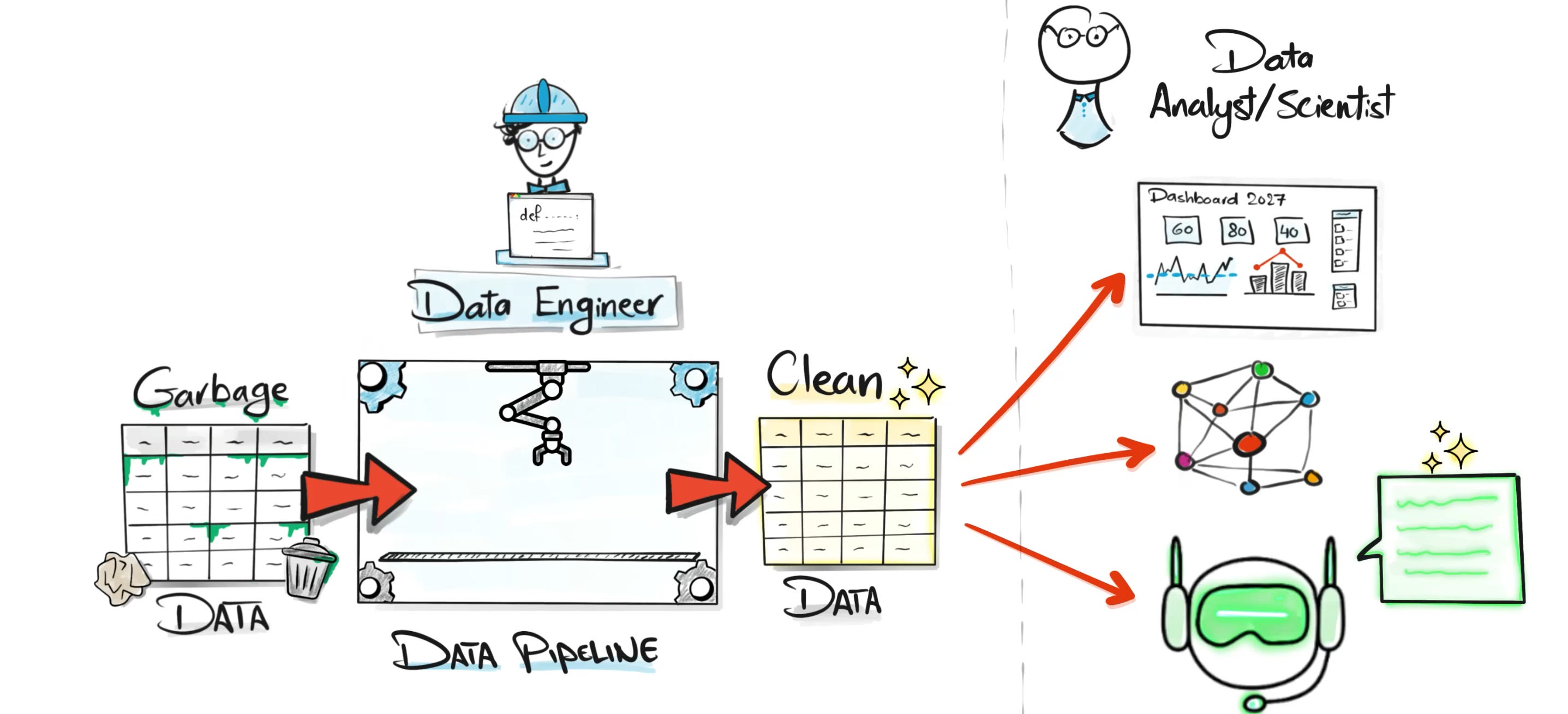
Will AI Replace Data Engineers?
Now let’s look at data engineers.
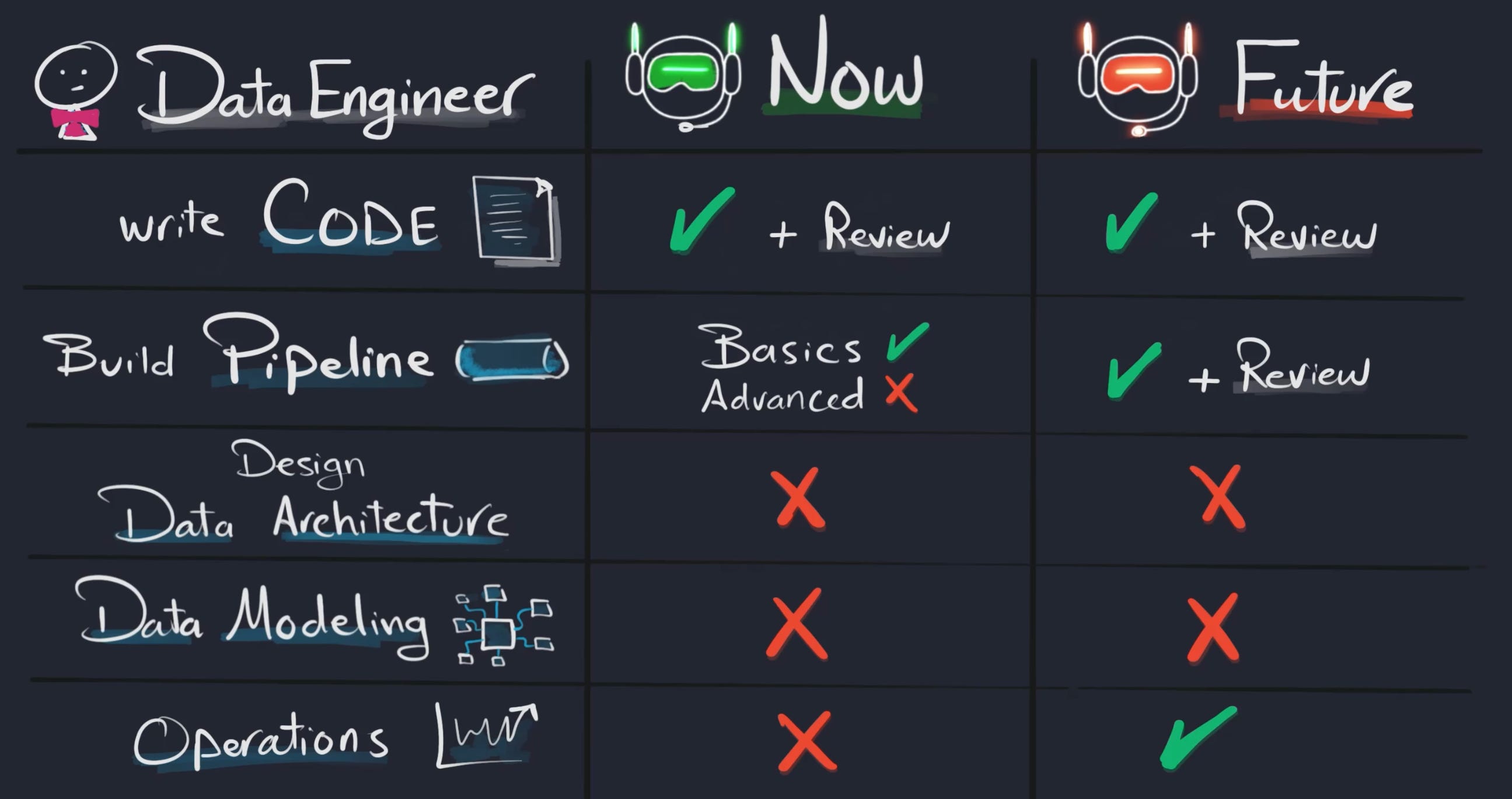
Coding:
AI is already very strong here. It can generate SQL, Python, and Spark code quickly. And this will only improve.
Build data pipelines:
AI can already create simple ones, and in the future, it will likely handle much more. Still, someone needs to review before anything goes to production.
Architecture:
Designing how systems are structured. Choosing between lakehouse or warehouse. Defining layers. Handling performance and scalability.
This requires deep understanding of both the technical side and the business context. It’s not something you can fully automate.
Data Modeling:
This is one of the hardest parts. You need to understand how different data sources connect, how data will be used, and which modeling approach makes sense.
Even experienced engineers find this challenging.
I don’t see AI replacing this anytime soon.
Operations:
Operational tasks like monitoring pipelines can be automated. AI can detect issues, suggest fixes, and possibly resolve them.
So again, the same pattern appears.
If someone is only coding and building pipelines, their work can be automated.
But if they understand systems, architecture, and data modeling, they become extremely valuable.
The role of data in the AI world
There is one important idea that didn’t change.
Before AI, we already knew:
Bad data leads to bad analysis.
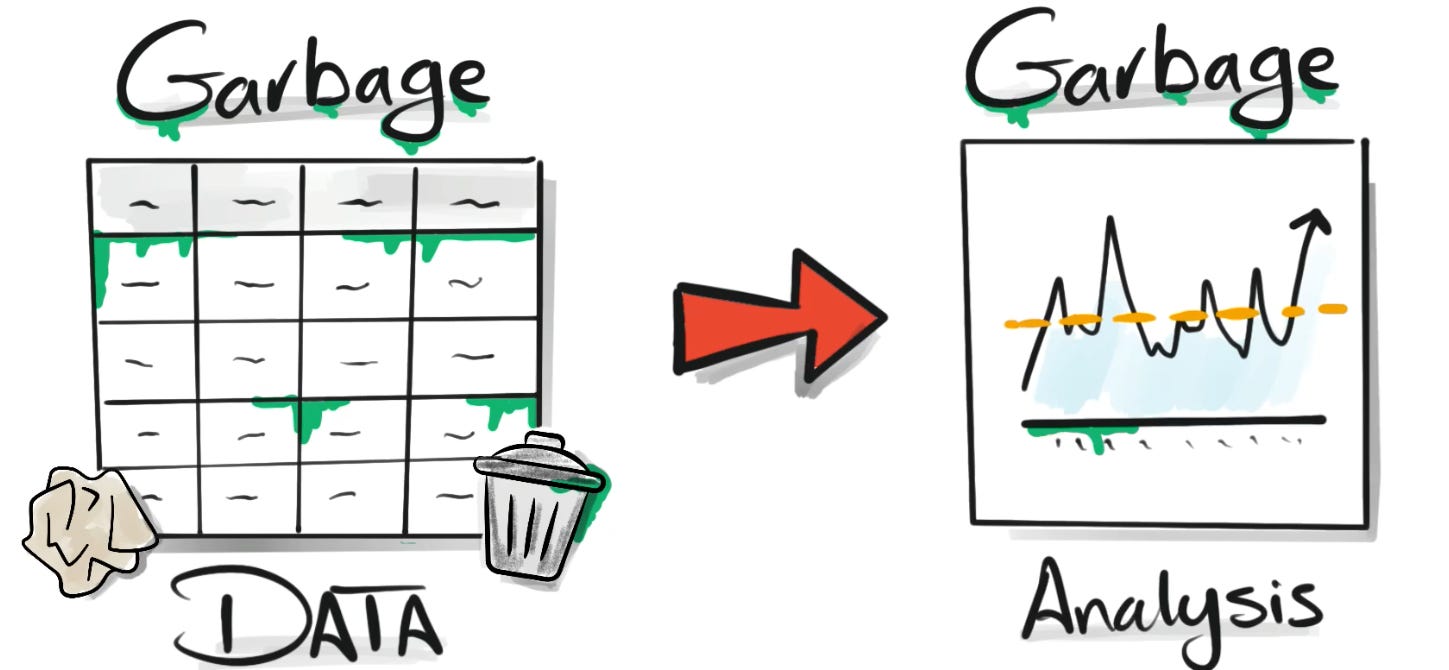
Now with AI, it’s exactly the same.
Bad data leads to bad results.
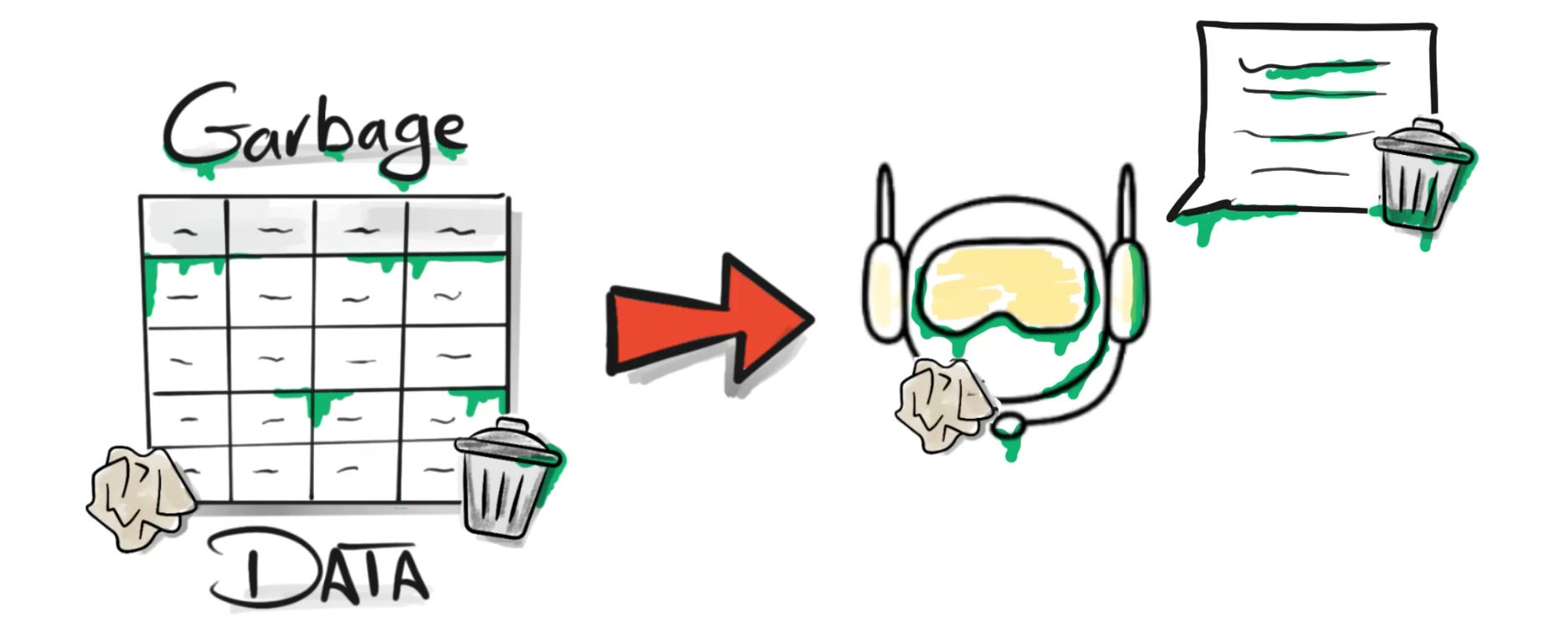
So someone still needs to prepare that data properly. And this is why data roles are not disappearing. They are evolving.
So …
AI is not replacing jobs in a simple way.
It’s replacing parts of jobs.
The repetitive parts.
The mechanical parts.
The parts that don’t require deep thinking.
But the more you move toward understanding, decision-making, and communication, the harder it becomes to replace you.
If you’re thinking about your future, don’t try to compete with AI. Work with it.
Learn how it fits into your field. Use it to move faster, but don’t let it replace your understanding.
For me, AI is not something to fear. It’s something that removes the boring parts of the job and lets you focus on what actually matters.
And over time, you’ll start to see clearly what is real and what is just noise.
If you’re still here, I appreciate it.
Much love,
— Baraa
Also, here are 4 complete roadmap videos if you’re figuring out where to start:
📌 Data Engineering Roadmap
📌 Data Science Roadmap
📌 Data Analyst Roadmap
📌 AI Engineering Roadmap

Hey friends —
Hey, I’m Baraa, a Data Engineer with over 17 years experience, Ex-Mercedes Benz, where I led and built one of the biggest data platforms for analytics and AI.
Now I’m here to share it all through visually explained courses, real-world projects, and the skills that will get you hired. I’ve helped millions of students transform their careers.
Great post. Didn't think about teams scaling with AI. Though I'm guessing the talent they are looking for are folks who know how to use AI to increase their productivity.