

Hey friends - Happy Thursday!
A friend called me a few days ago and asked a question that a lot of people think about quietly.
He said he wants to become a data analyst, but he has no degree, no experience, and he feels too old to start. He is almost 40. He told me it feels impossible.
And this is the part that hurts the most.
The job market feels tough. Companies ask for experience. And people fall into this loop.
I need experience to get a job, but I need a job to get experience.
If you are reading this and you feel the same, I want you to know something. It is possible. I have seen it many times. I have interviewed hundreds of candidates in my previous roles, and many of them got hired without a degree or experience.
But the game changed. The old way no longer works.
Just doing a few courses and applying for hundreds of jobs is not enough anymore. Today you have to show how you think, how you work, and how you solve problems. You have to give companies something real to look at.
So now let me show you how to do it!
The Two Phases

The Roadmap has two simple phases.
Phase1: you work in a sequential way. One skill at a time. This keeps things clear and easy to follow.
Phase2: Once you start applying for jobs, you switch to working in parallel. You apply, improve your skills, update your projects, and grow your portfolio at the same time.
Phase 1: Sequential. One thing at a time
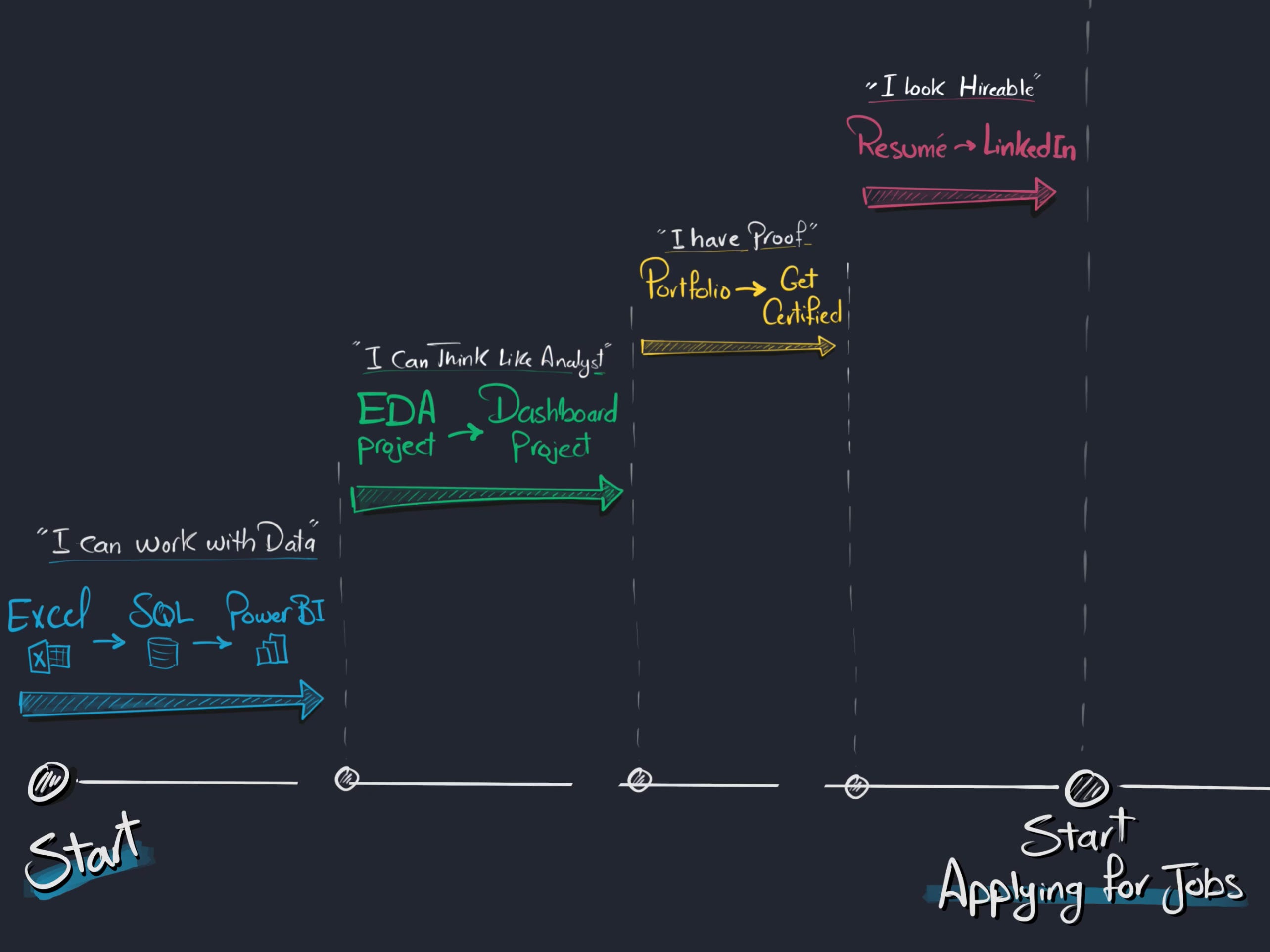
Step 1: I can work with data
You learn Excel, SQL, and a visualization tool like Power BI or Tableau.
This gives you the basics of cleaning data, exploring data, and showing insights.
Step 2: I can think like an analyst
You build two projects.
An EDA project in SQL and a dashboard project in Power BI or Tableau.
These teach you how to explore questions and explain what the data is telling you.
Step 3: I have proof
You collect your work in a simple portfolio and add a certificate if you want.
Now you can show real evidence of your skills.
Step 4: I look hirable
You prepare a clean one page resume and update your LinkedIn.
This makes it easier for companies to understand who you are and what you can do.
After these four steps, you move to Phase 2 and start applying for jobs.
Phase 2: Parallel. Multiple things at the same time

Phase 2 starts the moment you begin applying for jobs.
Your goal now is to build momentum. You improve your profile, your skills, and your projects all at once.
30 percent: Learn advanced topics
You go deeper into SQL and Power BI, and you start learning Python with Pandas.
You also add some basics of AI and prompt engineering.
This keeps your skills growing while you apply.
50 percent: Extend or build new projects
You improve the projects you already have or create new ones with better data and better analysis.
Strong projects make you stand out more than anything else in this phase.
10 percent: Improve your portfolio
You update your write ups, clean your explanations, and make your work easier to understand.
Small changes here make a big difference.
10 percent: Customize your resume and LinkedIn
You tune your resume for each application and stay active on LinkedIn.
This helps recruiters find you and understand your strengths quickly.
How to Handle Interviews
Interviews can feel stressful at the start, but they get easier with practice. Think of each one as a learning step, not a test. You learn what to say, what to fix, and how to explain your work more clearly.
The most important thing you prepare is your project story.
You explain the problem, the tools you used, the steps you took, and what you found. Walk them through your thought process. This is what tells the interviewer that you can think like an analyst and solve real problems.
Be honest about what you know and what you do not know.
Confidence here does not mean being perfect. It means showing ownership of your work and staying calm as you explain your steps.
And remember that companies are not only looking for technical skills. They want to see how you approach problems, how you communicate, and how you work through uncertainty. These parts often matter more than any single tool or function.
If you treat interviews as conversations, not pressure moments, you will perform much better. Each one moves you forward.
So my Friends…
You can start this path with no degree and no experience. I have seen many people do it. The roadmap is simple. You learn the core skills, build real projects, create your proof, and keep improving while you apply. It takes time and patience, but it works.
Thank you for reading. I hope this guide gives you a bit more clarity and helps you take your next step with more confidence.
Have a wonderful day ❤️
Baraa
Also, here are 4 complete roadmap videos if you’re figuring out where to start:
📌 Data Engineering Roadmap
📌 Data Science Roadmap
📌 Data Analyst Roadmap
📌 AI Engineering Roadmap

Hey friends —
I’m Baraa. I’m an IT professional and YouTuber.
My mission is to share the knowledge I’ve gained over the years and to make working with data easier, fun, and accessible to everyone through courses that are free, simple, and easy!